

Tales Without Words: Passionate Piano Concert
October 15 @ 7:00 pm - 8:30 pm

An evening of intimate storytelling through music by Bach, Chopin and Medtner.
The evening opens with Medtner’s Sonata Reminiscenza, a piece that feels like a memory rising to the surface before it has found words — searching, tender, incomplete. It leads into Bach’s English Suite No. 2 in A minor, where storytelling takes on the shape of Baroque dance, full of life, wit and reflection.
From there, Bach’s English Suite No. 3 in G minor returns to that same courtly language in a darker key, setting the stage for Chopin’s Ballade No. 1 in G minor, a piece that behaves like a story in the truest sense: it has a beginning, a rising tension, and a conclusion that arrives less like a resolution than an inevitability.
Performed without intermission, as one continuous journey.
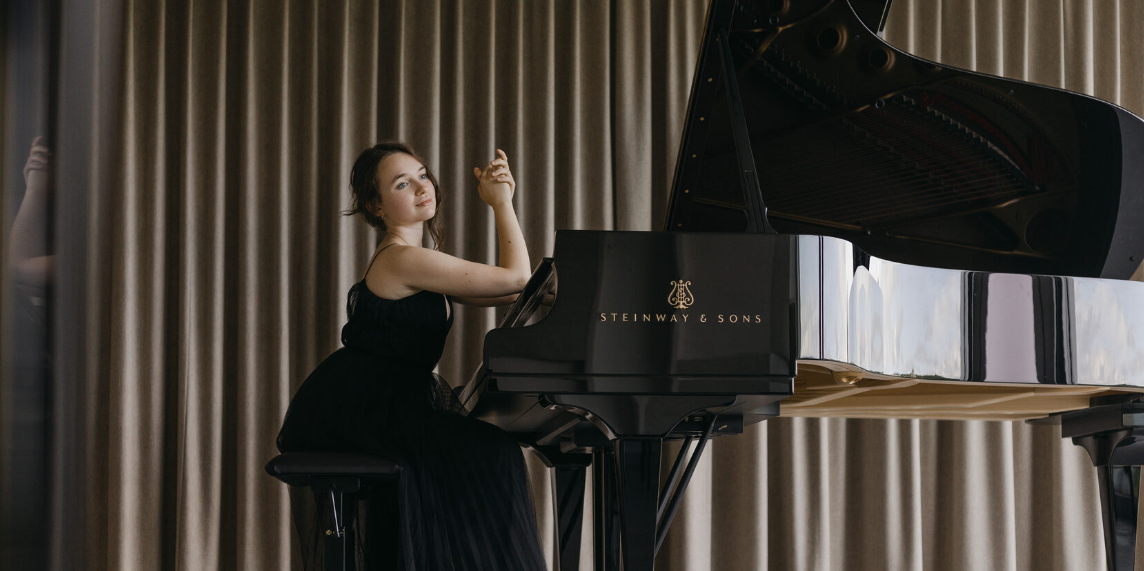 Daria Vasileva is a passionate concert pianist and project author who inspires not only her listeners but also her more than 80,000 subscribers on social networks, all united by their love for classical music. Daria received a classical education at one of Russia’s largest conservatories, in Kazan, where she honed her skills as a concert performer, ensemble artist, accompanist and teacher.
After graduating from the conservatory and winning several international competitions, including Smetana International Piano Competition in the Czech Republic, Daria was awarded an ESKAS grant from the Swiss government to study at the University of Applied Sciences and Arts in Lucerne. Under the guidance of Professor Benjamin Moser, Daria became captivated by performing the music of Alexander Scriabin, one of the most passionate and emotionally renowned composers in the world. Scriabin’s music resonates particularly well with Daria’s vibrant and open-minded character. In 2024 Daria won Second Prize (ex aequo, First prize was not awarded) and Special Scriabin Prize at XXVI International Scriabin Competition in Grosseto, Italy.
“With the highest degree of identification, Mrs. Vasileva succeeded in bringing each sonata to life with its own characteristics. She used her wonderful pianistic skills, her sense of sound, and her understanding of connections to serve the works. Her performance was of great intensity, freedom, and clarity, both in the restrained, delicate moments and in the exuberant, unstoppable crescendos.”— Tobias Schabenberger, German-Swiss pianist, Professor at University of Applied Sciences and Arts Northwestern Switzerland